You are using Internet Explorer and will not be able to use our website properly. Please change to an up-to-date browser for ideal presentation of the website.
More power, greater reach: KUKA robots in glass production
LiSEC, a machine builder located in Lower Austria, is now using KUKA robots to load tempering beds for the first time ever.
Machines for the sheet glass industry are the business of LiSEC GmbH
The product range starts with glass cutting and sorting systems, individual components and complete production lines, as well as glass edge processing machines and tempering systems and continues onto the corresponding software and appropriate services. “Our customers use our machines to process and finish insulated glass for glass facades, or glass for staircase railings, for example,” explains Bernhard Leitner, Product Manager for Logistics at LiSEC. In nearly 60 years’ time, the small glass processing company founded by Peter Lisec in 1961 has grown into a globally active mechanical engineering group with currently around 1,250 employees, approximately 800 of whom work at the headquarters in Seitenstetten, Austria. In addition to Europe, the company’s largest sales markets include the USA, China, Australia and New Zealand. Its customer list around the globe includes well-known window producers, facade manufacturers, glass processors and more.?“For large corporations and medium-sized companies in the sheet glass industry, the degree of automation is becoming increasingly significant,”adds Andreas Mader, Technical Expert & Project Coordinator at LiSEC. The Lower Austrian company is taking full account of this, not least through end-to-end?digitalization and the integration of production control software and machine control?into a higher-level system group.
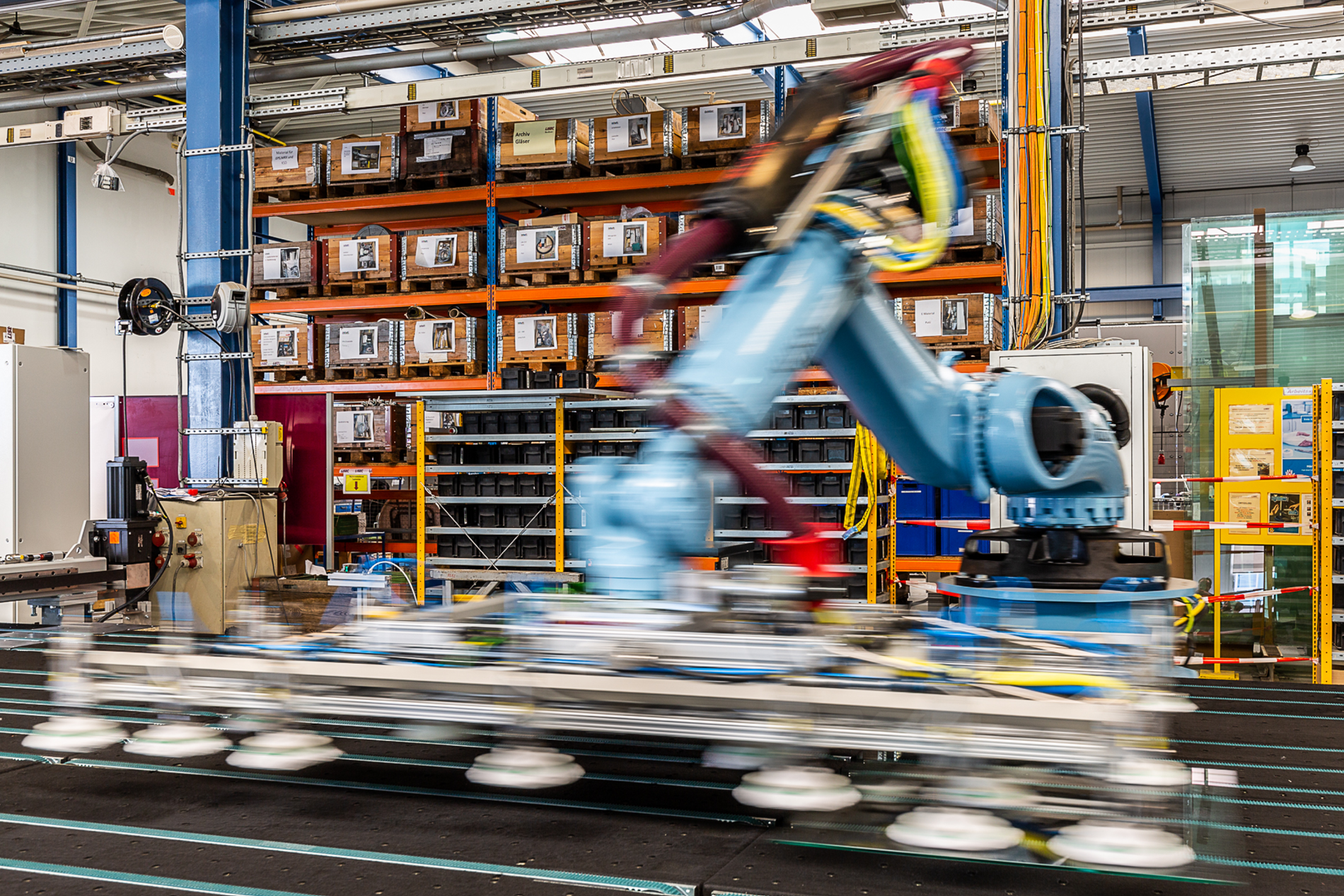
KUKA robot in use at LiSEC (c) Martin Gold
The corresponding expertise in the sheet glass machinery industry?
In order to have these solutions under the company’s control, LiSEC develops the software in-house. Leitner:?“Our customers benefit because we are the only company in the sheet glass machinery industry that can also comprehensively plan and carry out large projects.”?Besides the broad range of products, software is the key here. It does not take long to outline our recipe for success:?expertise. Leitner explains:?“We know the internal production processes of the glass processing industry in depth; we know about their planning and execution as well as their inherent challenges.”?This results in broad-based?engineering expertise. At the same time,?LiSEC?is in the fortunate position of being able to learn from itself time and again. This is because the company operates its own glass processing plant:?Glastech Produktions- und Verfahrenstechnik GmbH. This is also where the origins of the company lie. And this ambition to always build the best machines for themselves turned into the?core competency of the company based in Lower Austria. The intensive internal knowledge transfer is reflected in the quality of the machines and systems – and is appreciated by customers the world over.
Compared to roller conveyor systems, the robot scores high in terms of flexibility and repeatability (c) Martin Gold
Heat distribution determines positioning?
As noted, automation?plays an important role for many of LiSEC’s customers. So it was only a matter of time before?robots made their way into sheet glass production?– in this specific instance for the?loading and unloading of the tempering bed. In the annealing oven, insulated glass is heated to just under 700°C and then cooled very quickly by means of air flow. This process, which on the surface appears to be simple, is quite complex. It is because – if the annealing oven is to be operated with high throughput rates – such things as the thermal inertia of the transport rollers must be taken into account, as well as air turbulence generated during the process. Complicating matters further is the fact that the glass plates are usually of different sizes. If errors occur here – in other words, if there is an uneven distribution of heat on the glass plate – slight ripples form on the surface, which permanently reduce the quality of the glass since these, for example, severely disrupt the visual impression of a glass facade. LiSEC meets this challenge through the?optimized loading and unloading of the tempering bed. The?insulated glass layers assembled in the correct sequence?are fed piece by piece to the tempering bed in a specific variable position according to a highly sophisticated software calculation, which takes the thermal conditions in the annealing oven into account as far as possible. The example illustrates the value of?in-house software development?at LiSEC.
Naturally, loading and unloading the tempering bed is completely set up and tried and tested before delivery.(c) Martin Gold
Advancements in flexibility?
“In addition to these big challenges comes the customization of the system for each customer,” notes Bernhard Leitner. “Here, too, we offer a high degree of flexibility, right down to different configurations and temperatures - depending on the season.” One thing becomes quickly apparent here: without a deep understanding of the process and comprehensive expertise – particularly in software parameterization – one’s chances in the market are slim to none. Nevertheless, everything depends on the exact positioning of the glass before it is placed in the annealing oven. Up to now, this task was accomplished by means of roller conveyors, however these had clear disadvantages: they took up a lot of space and flexibility was low – since only predefined, fixed reference positions were possible. LiSEC is now using a robot for this purpose in a system for an Australian customer for the first time worldwide. The advantages of this quickly become apparent: the flexibility in positioning is now, by its very nature, enormous – going so far that glass plates can now even be fed in rotated to the annealing oven. “However, with glass plate dimensions of 3.30 m in width, the reach capability of the robot is also a determining factor,” notes Leitner. With requirements like this, what the robot market has to offer quickly becomes limited.
The ease of operation and the comprehensive KUKA service package are very convenient for users. (c) Martin Gold
High payload with a long reach
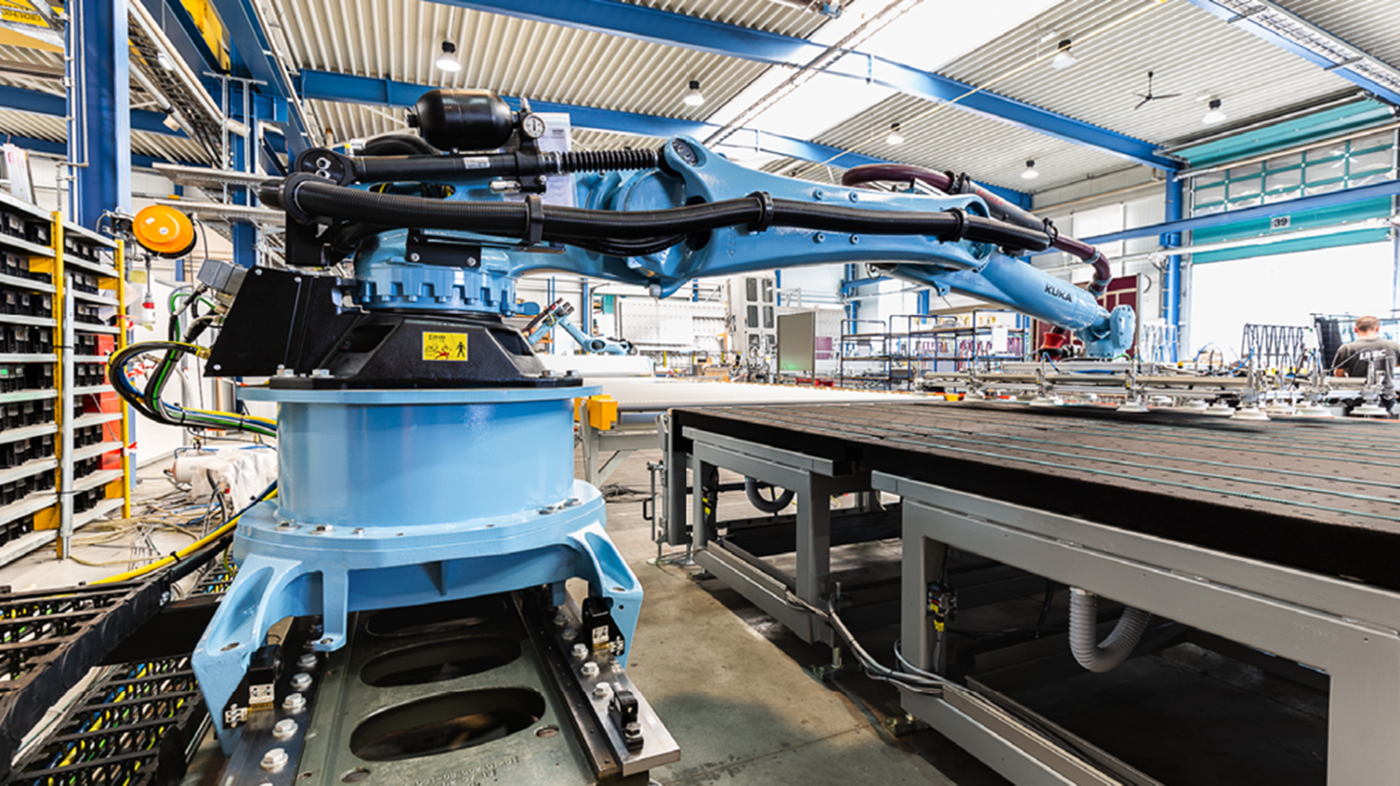
This is where?KUKA?comes in – because thanks to its broad product range, a type was found in the portfolio of the?globally active robot manufacturer?that brilliantly meets this task. The six-axis?KR 180 R3500 ultra K?robot scores high with a 180 kg payload at 3.5 m reach and low weight. By the way: if the glass plates are heavier, they are not lifted by the robot, but rather pulled with air cushion support. The speed is high and so is the productivity – providing a significant increase compared to roller conveyors. Beyond this, there is a significantly lower maintenance requirement along with better accessibility at the same time.?“A further feature of the robot is the small footprint required,”adds KUKA Account Manager Alexander Ahrer. This also particularly comes into play with system modernizations where the available space is already limited.
The KR 180 R3500 ultra K six-axis robot has a payload of 180 kg at a reach of 3.5 m (c) Martin Gold
KUKA robots in use?
In these specific cases, the robot is positioned on the KUKA linear unit KL 4000 , which also has a slim design and is completely bolted on as well. Ahrer: “Welding work during installation is thus no longer necessary.” Naturally, the glass plates need to be treated gently so that their surface is not damaged. Here, too,?the sensitive gripping robot is much more advanced than a roller conveyor system.?The vacuum cups are also equipped with a special cover that prevents imprints as far as possible. And there is another big?advantage when using robots: repeatability of the entire process is increased, which results in a much easier identification of errors in the process.
We invest continuously to keep the operation of our robots as simple and as safe as possible, as well as to support customers through our expertise and engineering services. This applies especially to customers who are just getting started.
Service as an all-round package
“In addition to the technical performance, we were convinced by how easily the robot could be programmed and put into operation,”states Andreas St?ger, head of programming at LiSEC, in stressing the correctness of the decision. “We were also able to rely on KUKA’s support throughout. Service around the product were and continue to be excellent.” Incidentally: a second, identical robot unloads the furnace after the tempering process and rounds off the line.
From left: Andreas Mader, Technical Expert & Project Coordination LiSEC; Bernhard Leitner, Product Manager Logistics LiSEC; Andreas Stöger, Technical Expert Robotics LiSEC and Alexander Ahrer, Account Manager KUKA (c) Martin Gold
LiSEC RHH – Robot handling system for the loading and unloading of the tempering bed?