<sub id="for6y"><s id="for6y"><form id="for6y"></form></s></sub>

    <cite id="for6y"></cite>

        <s id="for6y"></s>
        亚洲一品道一区二区三区,国产无套粉嫩白浆在线,51妺嘿嘿午夜福利,人人妻人人澡人人爽人人精品av,欧美一区二区三区欧美日韩亚洲,欧美一本大道香蕉综合视频 ,884aa四虎影成人精品,国产精品久久久久久福利69堂

        Select your location:

        Location

        Mens-robot-samenwerking

        Human-robot collaboration: Welcome, fellow robot!

        Humans and robots already work together in production today. Robots support and relieve human operators, enable versatile automation steps and increase productivity. Human-robot collaboration (HRC) is an additional element that combines human capabilities with the efficiency and precision of machines.


        Cobots: the status quo of flexible production

        Flexible manufacturing in variable batch sizes with utmost efficiency – this is the challenge for the production of the future. To meet it, human-machine interaction will be required through all phases of robotic automation implementation – making it easier and faster to setup, install, commission, program, operate maintain and re-use robots in all applications.

        In today’s modern factories, many production steps are already automated using machines. Human knowledge, intelligence, flexibility, creativity and sensitive touch ensure the smooth running and quality of production processes.

        Alongside conventional industrial robots, collaborative, sensitive robots (“cobots”) can make it not only easier to commission and program them, but in many cases also work directly together with production workers, easing their workload. They can take on strenuous, ergonomically unfavorable and monotonous work, such as overhead work or the performance of repetitive tasks. Their floor space requirement is relatively low, as any safety equipment required can be designed to be extremely space-saving.

        With their integrated sensors, cobots make it possible to automate delicate assembly tasks – ranging from assembling automotive transmissions through to inserting rubber plugs or handling flexible parts.

        In the case of unexpected contact, an appropriate solution is defined for every application: either a stop is triggered or the cobot reduces its speed sufficiently to preclude the risk of injuries.

        When people and robots can work safely together, without fencing separating them, many conventional safety precautions become superfluous – humans and robots can share the same workspace without any concerns.

        KUKA Cobots

        Forms of HRC: coexistence, cooperation, collaboration between humans and robots

        Depending on the area of application, humans and cobots can work together with varying degrees of proximity. Even though the term “human-robot collaboration” is the one most commonly used, the “C” in HRC can stand for various different forms of cooperation.

        Coexistence: Humans and robots work in adjacent workspaces without safety fencing. They do not, however, share a common workspace and work independently of one another on different tasks. In this case, the sensitivity and safety of a cobot can greatly ease and speed the commissioning, programming and re-use due to handguiding, teach training, and the lightweight nature of most cobots.

        Cooperation: In human-robot cooperation, humans and robots work in the same workspace. They work alternately on different tasks within a process. There is no direct interaction. This type of collaboration calls for fenceless operation, either because the cobot is inherently safe or the workspace is protected with sensors.

        Collaboration: Humans and robots interact in a shared workspace. For example, the robot passes something to the human operator, or they simultaneously perform different tasks on the same workpiece.

        The new generation of robotics

        KUKA started a new chapter in the history of industrial robotics when we introduced the LBR iiwa. As the first series-produced sensitive robot suitable for human-robot collaboration, the LBR iiwa has opened up new areas for robotics that were previously closed to automation.

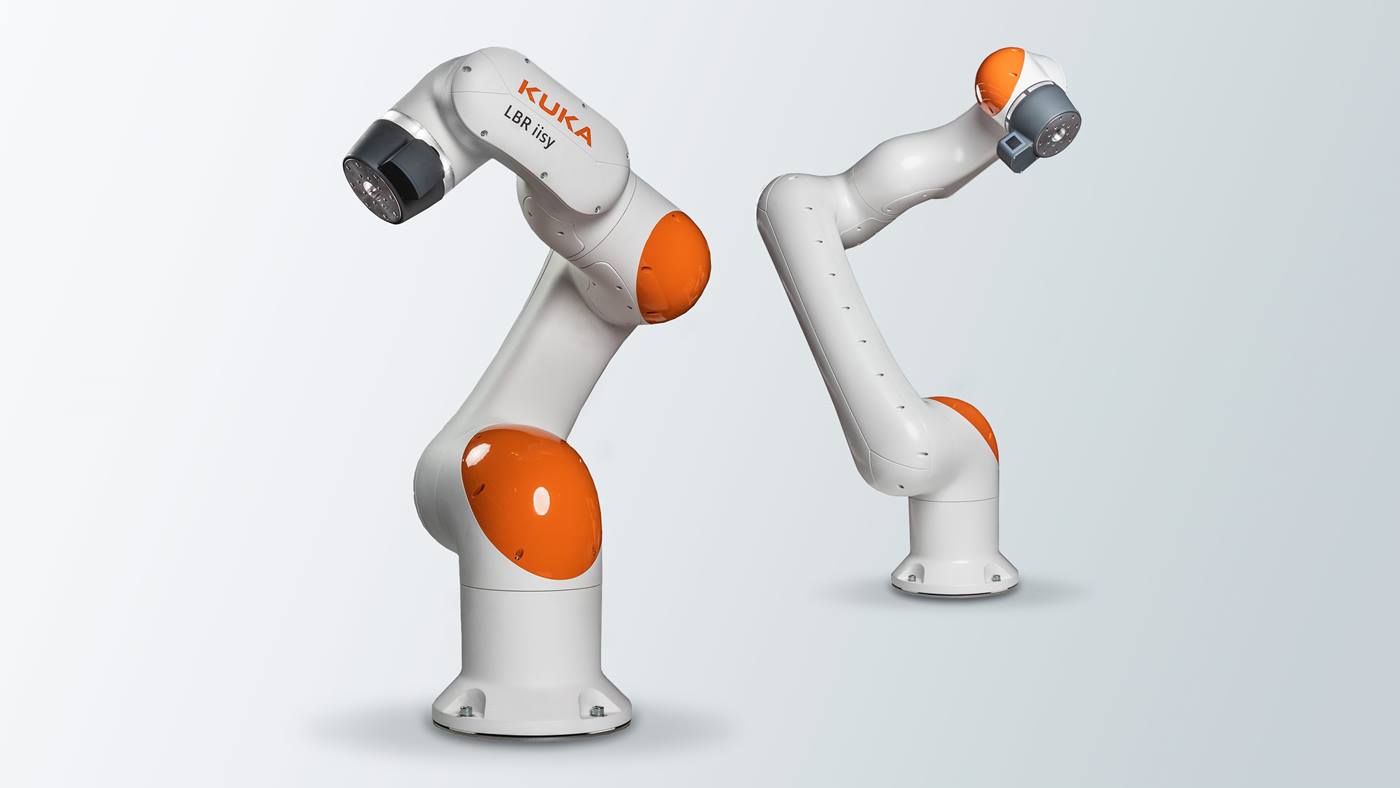
        With the addition of the LBR iisy to KUKA’s cobot portfolio, we cover a large range of cobot applications, from the simplest to the most complex. The LBR iisy represents the beginning of the next generation of cobots from KUKA running on iiQKA.OS and supported by the iiQKA Ecosystem.

        *The LBR iisy is available in the iiQKA Pre-Launch Package for a small number of customers starting at the end of 2021 and scaling in availability during 2022. Please check our iiQKA – Robots for the People page for more information. 

        These collaborative, sensitive and lightweight cobots can make it much easier and faster to implement robotics, and also make it possible for humans and robots to work directly together on highly sensitive tasks. Areas of application range from assembly, testing and material handling, to adhesive bonding processes in industrial production.

        This is because cobost are not only extremely precise and flexible, but can also be deployed safely in a wide range of different working environments.

        Mens-robot-samenwerking maken veilig en effici?nt werken op maat mogelijk.
        Human-robot collaboration enables safe and efficient precision work.

        Human and robot – hand in hand for BMW

        Whereas in the past workers at the BMW plant in Dingolfing had to lift and join heavy bevel gears for front-axle transmissions by themselves, today they work together with their collaborative colleague, the LBR iiwa.

        With the HRC solution developed specifically for the customer, KUKA enables the car manufacturer to automate arduous production steps that were previously carried out manually and permanently ease the workload of its employees. Its sensors detect contacts immediately and the LBR iiwa responds without delay. This enables close cooperation between human and robot entirely without safety fencing.

        Perfectly coordinated team. Perfectly adjusted headlights.

        Car maker Ford’s German slogan “Eine Idee weiter” translates as “An idea ahead”. Thanks to KUKA’s HRC expertise, the company is already several ideas ahead with the?automation of its production lines. On the headlight system test stands for the Ford Focus, for example, two KUKA LBR iiwa robots perform the ergonomically unfavorable fine adjustment of the fog lights while the operator adjusts the conventional headlights. Humans and robots work on the same vehicle without additional robotic safety equipment. As well as easing the workload of the worker, they also achieve greater adjustment quality and valuable time savings.


        The human and cobot share the production steps in a fast-paced work environment, ensuring enormous relief of our workforce.

        Michael Koch, Production Engineer at Ford

        Advantages of human-robot collaboration

        • Higher level of automation

          Cobots complement the capabilities of human workers and enable the fast automation of production steps that were previously performed manually.

        • Eased workload for employees

          Physically demanding, hazardous and monotonous work steps can be taken over by collaborative, sensitive robots. This relieves the burden on employees.

        • Consistently high quality

          Repetitive and high-concentration processes are performed by collaborative, sensitive lightweight robots with the utmost precision, thereby improving production quality.

        • Maximum flexibility

          The tasks of collaborative robots can be flexibly adapted. Furthermore, collaborative robots can be deployed in varying locations and with low space requirements.

        The next level: HRC meets mobile robotics

        The KUKA KMR iiwa?proves that mobile robots?can also be fully HRC-capable and move freely and safely in the work environment of the human.

        The KMR iiwa is a combination of the LBR iiwa and a mobile platform that can navigate autonomously using laser scanners and react flexibly to its environment.

        The combination of mobile and stationary cobots is also possible.?In the pre-setup area of a production line, for example, a KMR iiwa can deliver the workpieces while a stationary LBR iiwa supports the production personnel with assembly.

        HRC: Symbiosis of state-of-the-art robotics and traditional teamwork

        Human-robot collaboration is revolutionizing industrial production – and also playing a major role in other sectors, such as the medical technology sector.

        Automation expert KUKA is one of the primary driving forces at the forefront of this development with its sensitive, collaborative robots and intelligent software solutions.

        Medical robotics with a sensitive touch

        Thanks to HRC technologies, the sensitive LBR Med can be integrated into a wide range of medical applications.

        主站蜘蛛池模板: 午夜精品久久久久久久久久老司机| 国产精品无码一区二区在线| 久久综合精品国产一区二区三区无 | 亚洲高清WWW色好看美女| 欧韩一区| 国产丰满绿帽一区二区三区| 久久久久久人妻一区二区无码Av| 精品国产福利一区二区| 精品国产这么小也不放过| 亚洲中文无码人aV在线a| 人妻精品久久久久中文字幕19| 日韩色网| 国产乱子精品一区二区在线观看| 中文字幕有码无码AV| 久久精品第九区免费观看| 久久综合久久综合九色| 国产男女做爰高清全过小说| 国产精华AV午夜在线| 亚洲熟妇色自偷自拍另类| 老色99久久九九爱精品| 尤物一区| 午夜天堂精品久久久久| 国产99riav| 久久99精品久久久久久齐齐百度| 熟女在线国产| 亚洲第一区二区国产精品| 国产精品午夜福利合集| 亚洲VA久久久噜噜噜久久| 在线中文人妻| 老妇毛片久久久久久久久| a天堂一码二码专区| 91孕妇精品一区二区三区| 亚洲无人区码二码三码区| 亚洲日本va午夜在线影院| 另类 专区 欧美 制服| 欧美日韩一区二区视频图片| 永久免费男同AV无码入口| 亚洲国产高清在线观看视频| 亚洲精品色哟哟一区二区| 99啪啪| 国产女人18毛片水真多1|