<sub id="for6y"><s id="for6y"><form id="for6y"></form></s></sub>

    <cite id="for6y"></cite>

        <s id="for6y"></s>
        亚洲一品道一区二区三区,国产无套粉嫩白浆在线,51妺嘿嘿午夜福利,人人妻人人澡人人爽人人精品av,欧美一区二区三区欧美日韩亚洲,欧美一本大道香蕉综合视频 ,884aa四虎影成人精品,国产精品久久久久久福利69堂

        Select your location:

        Location

        KUKA robots and software get students at Rosenheim University of Applied Sciences up and running in robotics

        Learn how to handle industrial robots as a specialist of the future: in the assembly and robotics laboratory at Rosenheim University of Applied Sciences. Students learn to design specific practical applications in cells. KUKA, which has had links with Rosenheim University of Applied Sciences for many years, supplied simulation software and industrial robots, such as the KR AGILUS, and lightweight robots, such as the LBR iiwa.

        3 November 2016


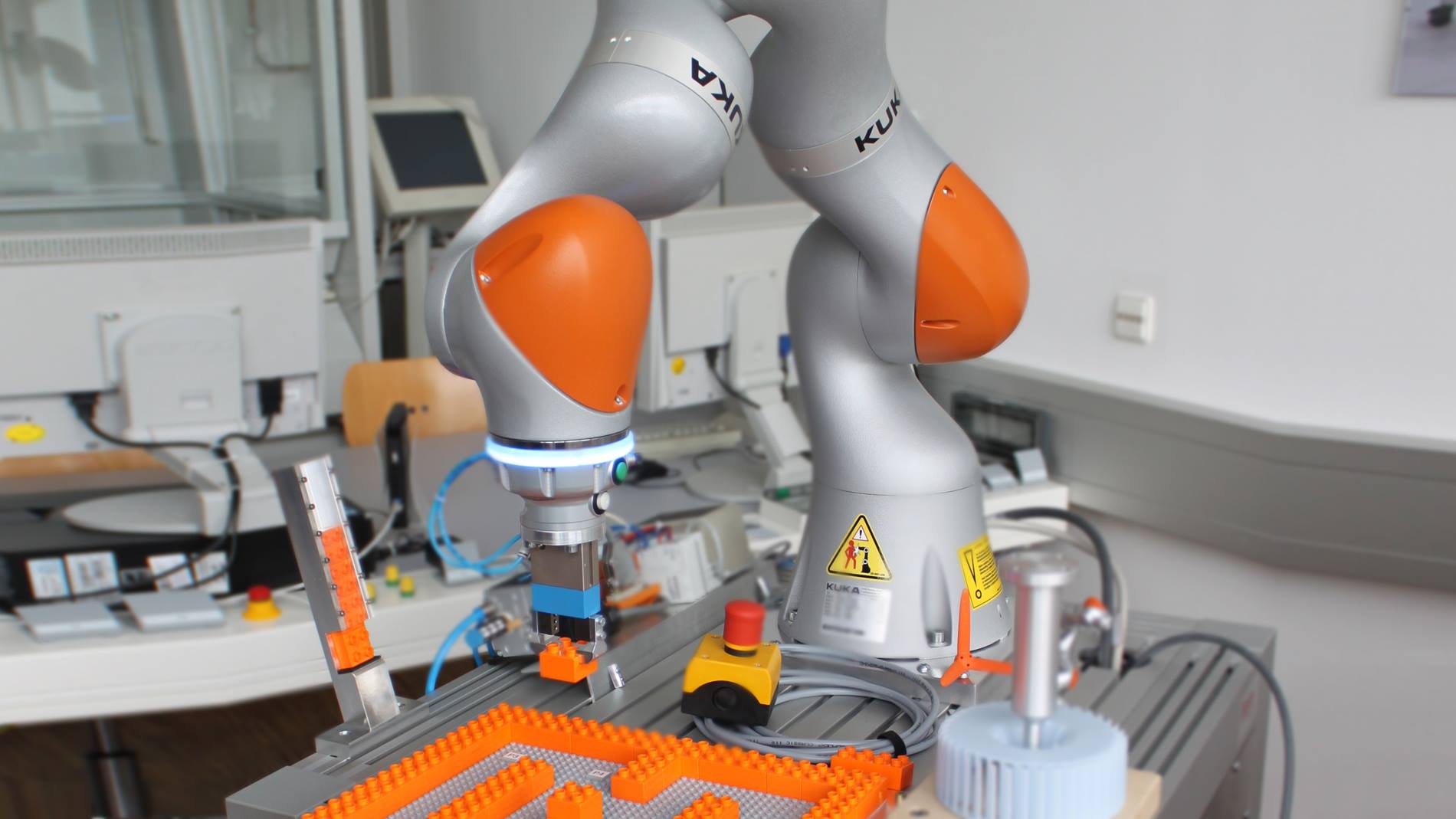
        靈敏的 LBR iiwa 帶著夾持工具通過一座由樂高積木堆成的迷宮。
        The sensitive LBR iiwa moves its gripper tool through a maze built from Lego bricks.

        LBR?iiwa solves tasks with a sensitive touch

        Many engineering careers are no doubt born in early childhood out of a fascination for Lego bricks and robots. The next step up the career ladder then occurs in the assembly and robotics laboratory at Rosenheim University of Applied Sciences under Prof. Dr. Christian Meierlohr. Using an application with the LBR iiwa from KUKA, engineering students no longer stack Lego bricks themselves. Instead, they leave this task to the sensitive seven-axis lightweight robot. The LBR iiwa picks up the pieces, stacks them and sensitively pushes them together. Lego mazes can be created in this way and the sensitive lightweight robot passes through them with its gripper. The students make use here of the robot’s sensitive ability to detect and avoid obstacles and collisions in order to find its way out of the labyrinth. Since the robot is mounted on a specially manufactured laboratory trolley, it can be moved freely around the room and thus flexibly used in other teaching events.

        Handling workpieces with a kuka small robot

        The KR AGILUS sixx small robot is extremely fast. It is located in a training cell with a transparent table, automatic workpiece supply by vibratory feeder and an image processing system for workpiece recognition. Depending on the study level – Bachelor or Master – it can be used to accomplish different tasks. Pick-and-place is a typical automation scenario. Here the robot is used to grip workpieces and position them accurately. The image processing system can also be used to recognize and sort different parts. Another task is programming the robot to find its way through a foam labyrinth.

        Programming by means of software simulation

        As far as programming is concerned, students can use the simulation software KUKA.Sim Pro to program robots offline on the PC and test the sequence with KUKA.OfficeLite In this way, they learn to create motion sequences that can be used, for example, in robotic cells for production and assembly. Following the simulated tests, the sequences programmed offline can be checked directly on the real machine and optimized under practical conditions. “Simulation is a good first step when planning what can be done with a robot, but sooner or later it reaches its limits. The real world behaves slightly differently from the simulated world in certain respects. That is why the ability to transfer the planning on the computer directly to the real robot and apply it there is so valuable,” says Prof. Dr. Meierlohr. Moreover, the integration of the simulation workstations makes it possible to divide the students into smaller groups that can work at multiple stations. This increases the intensity and success of the learning process. In this way, the students can work through the typical engineering tasks from planning through to real implementation.

        Get to know the collaborative lightweight robot LBR iiwa.
        Find out everything about the KUKA AGILUS series in the field of small robots here.
        靈敏的 LBR iiwa 帶著夾持工具通過一座由樂高積木堆成的迷宮。
        The sensitive LBR iiwa moves its gripper tool through a maze built from Lego bricks.

        LBR?iiwa solves tasks with a sensitive touch

        Many engineering careers are no doubt born in early childhood out of a fascination for Lego bricks and robots. The next step up the career ladder then occurs in the assembly and robotics laboratory at Rosenheim University of Applied Sciences under Prof. Dr. Christian Meierlohr. Using an application with the LBR iiwa from KUKA, engineering students no longer stack Lego bricks themselves. Instead, they leave this task to the sensitive seven-axis lightweight robot. The LBR iiwa picks up the pieces, stacks them and sensitively pushes them together. Lego mazes can be created in this way and the sensitive lightweight robot passes through them with its gripper. The students make use here of the robot’s sensitive ability to detect and avoid obstacles and collisions in order to find its way out of the labyrinth. Since the robot is mounted on a specially manufactured laboratory trolley, it can be moved freely around the room and thus flexibly used in other teaching events.

        Handling workpieces with a kuka small robot

        The KR AGILUS sixx small robot is extremely fast. It is located in a training cell with a transparent table, automatic workpiece supply by vibratory feeder and an image processing system for workpiece recognition. Depending on the study level – Bachelor or Master – it can be used to accomplish different tasks. Pick-and-place is a typical automation scenario. Here the robot is used to grip workpieces and position them accurately. The image processing system can also be used to recognize and sort different parts. Another task is programming the robot to find its way through a foam labyrinth.

        Programming by means of software simulation

        As far as programming is concerned, students can use the simulation software KUKA.Sim Pro to program robots offline on the PC and test the sequence with KUKA.OfficeLite In this way, they learn to create motion sequences that can be used, for example, in robotic cells for production and assembly. Following the simulated tests, the sequences programmed offline can be checked directly on the real machine and optimized under practical conditions. “Simulation is a good first step when planning what can be done with a robot, but sooner or later it reaches its limits. The real world behaves slightly differently from the simulated world in certain respects. That is why the ability to transfer the planning on the computer directly to the real robot and apply it there is so valuable,” says Prof. Dr. Meierlohr. Moreover, the integration of the simulation workstations makes it possible to divide the students into smaller groups that can work at multiple stations. This increases the intensity and success of the learning process. In this way, the students can work through the typical engineering tasks from planning through to real implementation.

        Get to know the collaborative lightweight robot LBR iiwa.
        Find out everything about the KUKA AGILUS series in the field of small robots here.
        主站蜘蛛池模板: 国产精品深夜福利在线观看| 人人人澡人人肉久久精品| 丁香五月中文字幕| 国产欧美日韩在线观看精品| 日韩一区二区在线观看的| 亚洲人成小说网站色在线| 欧美无人区码suv| 午夜精品视频在线观看| 天堂网在线最新版WWW中文网| 午夜免费无码福利视频麻豆| 久在线精品视频线观看| 国内精品大秀视频日韩精品| 色吊丝av中文字幕| 大香焦一区二区三区| 亚洲中文字幕精品一区二区三区| 99久久er热在这里只有精品99| 成人免费乱码大片a毛片| 国产精品国产三级国产试看| www.九九热| 91精品91久久久久久| 边摸边吃奶边做爽gif动态图| 人妻系列中文字幕久久| 在线亚洲+欧美+日本专区| 国产成人精品亚洲精品密奴| 国产精品国三级国产av| 2021国产三级精品三级专区| 亚洲中文另类| 丁香五月影院| 亚洲青涩在线不卡av| 久久不卡精品| 99国产精品永久免费视频| 99视频精品| 久久99国产乱子伦精品免费| 黄色av网站网址| 亚洲综合无码日韩国产加勒比| 精品精品国产理论在线观看| 99热精品国产三级在线观看| 国产无套护士精品毛片| 人妻聚色窝窝人体WWW一区 | 国产欧美国产精品第一区| 五月综合婷婷久久网站|