You are using Internet Explorer and will not be able to use our website properly. Please change to an up-to-date browser for ideal presentation of the website.
A firm grip on non-rigid parts: KR CYBERTECH automates battery pack assembly
Production of batteries for electric vehicles presents hazards because of the enormous voltage produced when battery modules make electrical contact. Together with KOSTAL Kontakt Systeme GmbH and KUKA, Liebherr-Verzahntechnik GmbH has used two KR CYBERTECH nano series robots to connect high-voltage battery modules safely and efficiently.
Automation gives e-mobility a push
The future belongs to electric vehicles. They are quiet, increasingly powered using renewable energy sources, cause lower CO2 emissions and lead to lower repair and maintenance costs. Around the globe, more than 27 million plug-in hybrids and electric cars are on the roads already. That number will rise significantly between 2030 and 2035, when many major countries put the brakes on the production of internal combustion vehicles. KUKA recognized the potential of e-mobility early on. In 2014, the Augsburg automation specialist began optimizing its product portfolio for the specific requirements involved in production of electronic components for the automotive industry. Now, Liebherr-Verzahntechnik GmbH in Kempten also benefits from this optimization – and has developed a robot-powered application that offers greater safety and higher productivity for manufacturers of electric vehicles and their suppliers.
Secure connection of high-voltage battery modules using a robotic solution
Two KR CYBERTECH nano ARC HW robots connect the modules of the high-voltage battery and take the safety and efficiency of battery production to a whole new level.
Robot-based assembly ensures greater safety in high-voltage battery production
What would an electric car be without its heart, the battery? This high-voltage power source contains an enormous amount of energy, and is critical to the vehicle's range and charging time. The HV battery consists of several modules electrically contacted with one another and connected to form a battery pack. Once connected, these battery systems achieve outputs between 400 and 800 V DC. However, the exposed contact surfaces of the busbars frequently used for this purpose pose a safety risk for employees.
Simultaneously, the robots move the plug-in module connectors down to the battery modules.
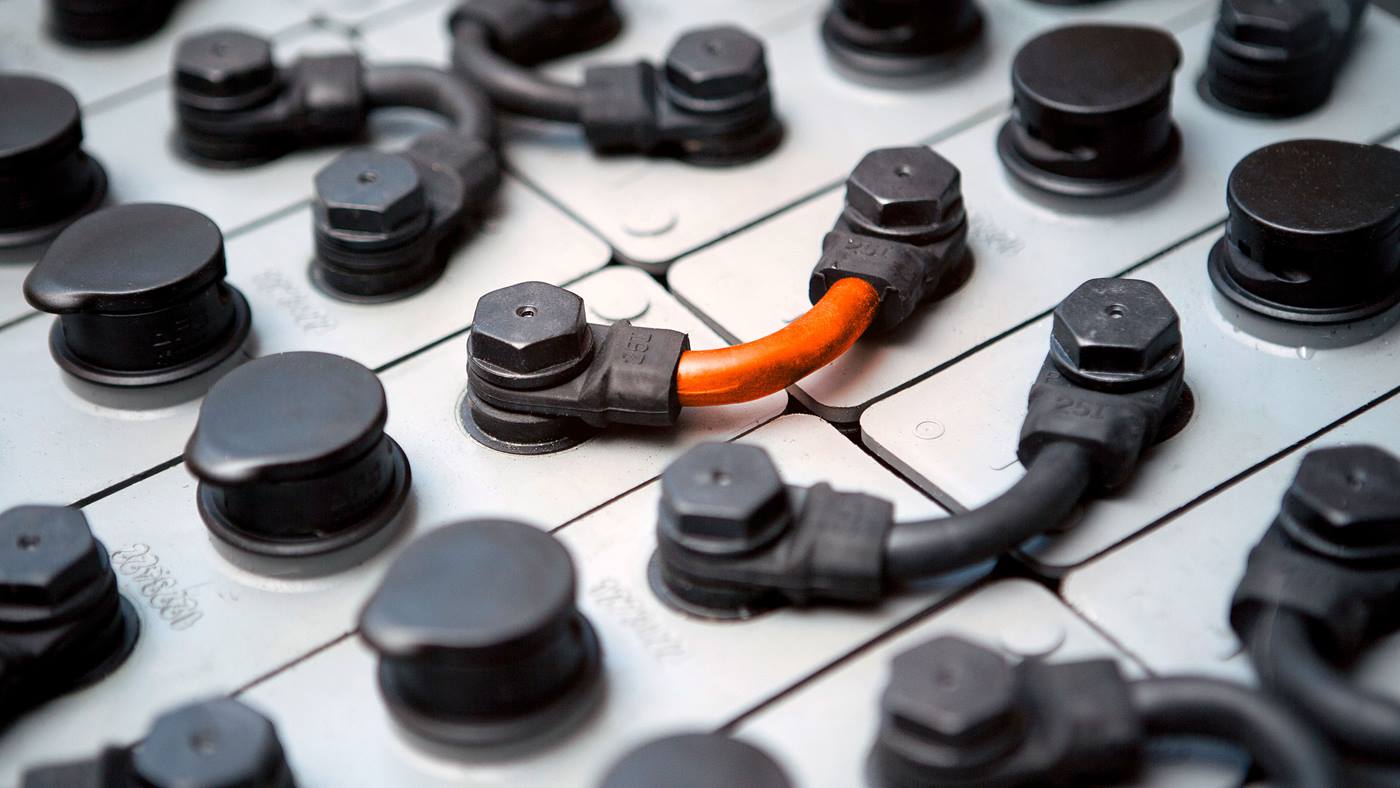
Plug-in module connectors provide an alternative. With the aid of KUKA robots, Liebherr-Verzahntechnik GmbH and KOSTAL Kontakt Systeme GmbH have developed an innovative process that automates the assembly of plug-in module connectors with flexible cables. Insulated and flexible plug-in module connectors from KOSTAL prevent accidental contact with current-carrying parts and, despite their high elasticity, can be plugged in automatically – with the required flexibility and cycle times.
Automation plays a key role in the cost-effective production of high-voltage batteries in large quantities.
E-mobility: a real innovation with hollow-shaft robots and special software
In each cell, two KR CYBERTECH nano ARC HW – typically used for arc welding – carry out the plug-in process itself. These compact hollow-shaft robots offer long reach and can route cables through their wrist axis, making them ideal for this application. In addition, the team at Liebherr-Verzahntechnik GmbH selected the KUKA.RoboTeam software package, which enables two or more robots to operate in synchronized cooperation. The program and motion compare with one another in real time for success even with complex processes such as joining non-rigid parts, achieving a real innovation in the field of electromobility.
Two KR CYBERTECH nano ARC HW robots working in a cell plug in the electronic connections.
The two robot arms work together synchronously in the production of high-voltage batteries, controlled by the KUKA.RoboTeam software package.
Lack of skilled workers drives automation forward
Today, most process steps in the production of batteries are already executed fully automatically to meet the automotive industry's requirements for cycle times, batch sizes, quality and production costs. The shortage of skilled workers also drives this strong trend toward automation. Increasingly, fewer skilled workers will take on such monotonous, physically strenuous and demanding tasks. KOSTAL Kontakt Systeme GmbH (Lüdenscheid), which has produced and sold plug-in connections for the vehicle industry since 1938, identified a gap in the market. It developed a connector that plugs in either manually or through automation. Martin Wolter, Group Leader for Development at KOSTAL, reported that “Safety plays a very important role here. Because these are high-voltage contacts, they must be protected against contact just as the contacts in an electric socket are protected from fingers. The difference is that the plug-in connection in the vehicle is subject to vibration stress and temperature extremes.”
Our system is very robust and reliably transmits current during the entire service life under changing loads.
The streamlined design of the KR CYBERTECH nano ARC HW makes it possible for two robots to fit into a compact cell.
A milestone in battery pack assembly for electromobility
KOSTAL then looked for an automation specialist to get the new product ready for series production and found what it was looking for in Liebherr-Verzahntechnik GmbH, headquartered in Kempten. Since 1969, the Allgäu-based company has been supplying innovative solutions to numerous automotive manufacturers and suppliers, and to customers in systems engineering, aerospace and construction machinery.
Viktor Bayrhof in front of the innovative cell - which was presented at the Battery Show after just a year and a half of development.
Viktor Bayrhof, Product Manager for Automation Systems at Liebherr, noted that “It was a win-win situation. As a relatively new player in the battery assembly business, we have found a unique selling point, while KOSTAL has found someone to automate their product.” Liebherr has been cooperating closely with KUKA for more than ten years. Together, the three companies got to work and, after just one and a half years, they were ready to exhibit the new robotic cell at the Stuttgart Battery Show.
Assembly: Robots plug in non-rigid cables
Their innovation attracted a lot of attention at the show because plug-in module connectors with flexible cables offer even more advantages than screw connections with busbars. They are easier to mount. Only the plug and its counterpart must connect to one another and the design can compensate for vibrations during vehicle operation, which reduces wear-related loss of electrical contact. They also offer advantages during subsequent replacement of the battery modules, for second-life applications or recycling of the battery pack modules. The only snag: They are non-rigid and thus deform even under low force and torque loads.
And the connection is in place – a hugely important step in the expansion of e-mobility.
Processing of non-rigid parts requires an optimal solution
Machine handling of non-rigid parts remains a major challenge in assembly. For example, elastic cables that can bend in any direction are difficult for robots to grip. Based on theKR CYBERTECH nano ARC HWLiebherr has developed a special gripper that removes the cables from a package. The cable is not pre-positioned accurately in the package, so a 2D camera helps determine the right gripping positions on the cable and position the module connector at the end of the cable exactly above the mating connector.
Using a 2D camera, the robots can precisely grip and plug in the non-rigid parts of the high-voltage battery.
Spring assemblies for exactly the right application of force
The plug must be handled carefully, so the plug-in process has been separated for a smooth sequence. A spring assembly controls the force transmitted to the connector and the Connector Position Assurance, or CPA. A pneumatic cylinder then presses the connector into the mating connector. This spring assembly compresses until it reaches a torque of 70 Newton meters, which triggers the end position sensor. At the same time, the spring-mounted locking pin presses the CPA downwards. Thus, the CPA locks, the connector plugs in correctly and the gripper can move back up again. In contrast to other automation experts, Liebherr deliberately avoids trial-and-error processes as a solution for the plug-in process of non-rigid cables. Every move must be just right for the technology to meet the cycle-time requirements of series production. The system has more than succeeded: It cut the allotted cycle time of 17 seconds by six seconds.
Optimal performance with the right combination of robot and software
This automation process relies on the KUKA KR CYBERTECH nano ARC HW, a flexible, cost-effective industrial robot that specialises in working with small components and that can reach positions that are difficult to access. Protection against uncontrolled electrostatic charging or discharging (ESD) makes this robot ideal for handling sensitive electronic components. The streamlined robot makes optimal use of small spaces and even fits in compact robot cells.
The KUKA smartPAD teach pendant can be used to track and control every step in battery production.
With the KUKA.RoboTeam software, Liebherr makes two grippers work cooperatively, optimally imitating human arms. This way, the robots compensate for position tolerances while they handle different cable lengths and connection positions. Integrated image recognition helps determine the real positions of the slots. Best of all, this solution also works with other flexible components in battery production. For example, it automates the connection of data cables between the Battery Management System (BMS) and Cell Management Controller (CMC).
High quality standards: equipped for electromobility
Martin Klaus, the Global Business Development Manager Electronics at KUKA who is responsible for automotive electronics, says that automation will be a necessity for many companies in the automotive industry to remain competitive. “The trend toward battery-powered electric cars with increasingly advanced technology significantly increases the number and variety of complex electronic components in the car,” he emphasized. According to Klaus, these components, including inverters, electric motors, displays, cameras and control units, “only can be manufactured in the required quality and quantity with a high degree of automation.” KUKA is prepared for this, with a portfolio of ESD-protected robots certified for clean room and dry room applications.
The interaction of hardware and software makes the individual components very easy to control.
Robotics can be used to implement a wide range of processes required in electronics manufacturing.
New future-proof partnership for battery pack assembly
Viktor Bayrhof of Liebherr agreed with Martin Klaus. “High-voltage battery systems are the most expensive component on an electric vehicle,” said Bayrhof. “Automation plays a key role in cost-effective, high-volume production of these batteries.” Together, KUKA, Liebherr and KOSTAL developed a solution that can safeguard competitiveness even in turbulent times. It enables manufacturers to keep a firm grip on their production – and, quite literally, on non-rigid parts – at all times.